There’s a calm point in training when you realize you’re no longer working for a reflection in the mirror or a number on a scoreboard. You’re training for how your body moves through daily life: climbing stairs without effort, lifting a suitcase with confidence, or catching yourself if you lose balance. That’s where athletic gymnastics fits in. It’s a practical, structured way to build strength that serves real life, not just the gym. Follow along, and you’ll see how this approach helps you get stronger in a steady, sustainable way.
What athletic gymnastics actually means
Athletic gymnastics is a method of strength training centered on whole-body control, balance, and usable power. Instead of pushing maximum weights, the focus stays on smooth execution, stable positions, and manageable loads. The aim is a body that feels capable and responsive rather than worn down or stiff. This makes it suitable for a wide range of ages and fitness backgrounds, especially when paired with light mobility work for joints and the spine.

Workouts emphasize posture, coordination, and joint-friendly movement ranges. You’re training your body to handle everyday demands with ease: carrying shopping bags, playing with children, rearranging furniture, or staying comfortable during long days of activity. The result is functional strength that supports your lifestyle instead of limiting it.

Main exercise categories in athletic gymnastics
This training style blends several types of exercises. Together, they create a balanced system where intensity can be adjusted without losing focus on control and quality.
– Bodyweight movements. Exercises like push-ups, holds, and strength poses using your own body mass. These are usually performed for about 8–15 repetitions or 10–30 seconds per hold to develop foundational strength and stability.
– Gymnastic apparatus work. Bars, parallel bars, and rings challenge coordination and body awareness. Movements are controlled and deliberate, avoiding excessive momentum.
– Light equipment and accessories. Resistance bands and medicine balls build endurance, coordination, and reaction. These tools are often used in solo or partner drills to add variety.
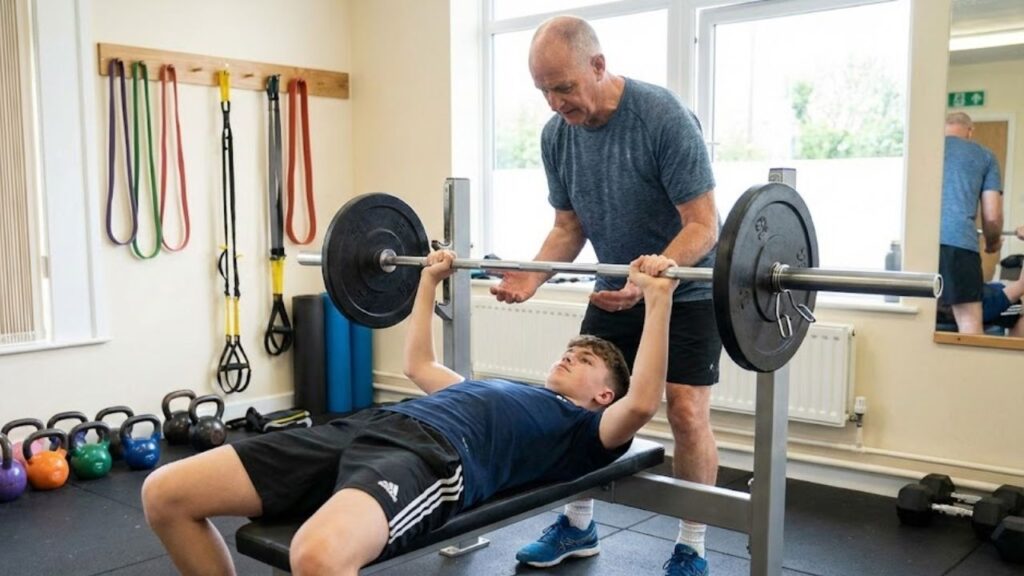
– Free weights. Dumbbells, kettlebells, and barbells are included at moderate loads. The focus remains on steady strength and muscular endurance rather than maximal lifts.
– Partner and group drills. Working with others adds unpredictable resistance, improves balance, and builds practical strength through shared movement.
– Machines. Used at a controlled pace, machines allow precise load management and help strengthen weaker areas safely, especially when stability is a priority.
When strength becomes a skill rather than a score, training feels more engaging and sustainable.
From personal experience, blending these elements keeps workouts interesting while protecting my joints. A mix of ring work, controlled resistance training with dumbbells, and basic bodyweight exercises gives me a strong “ready for anything” feeling. That quiet confidence from consistent strength training is far more rewarding than chasing a single record.
How often to train and session length
If you’re starting out, a practical plan is 2–3 sessions per week lasting around 20–30 minutes. As your body adapts, you can increase to 45–60 minutes and train a bit more frequently. The key guideline is that your final repetition should be challenging but still smooth, with solid technique and no strain.
General fitness recommendations align well with this model: strength work for all major muscle groups on at least two days per week, along with roughly 150–300 minutes of moderate aerobic activity or a comparable mix with higher intensity cardio. Athletic gymnastics fits naturally into the strength portion of these guidelines.

Sample weekly structure by experience level
| Experience Level | Recommended Weekly Training Structure |
|---|---|
| Beginner | Train 2–3 days per week with sessions lasting around 20–30 minutes. Focus on full-body workouts, performing 1–2 sets per exercise to build a strong foundation and proper movement technique. |
| Intermediate / Advanced | Train 3–4 days per week for 45–60 minutes per session. Programs may include full-body or split routines, using 2–4 sets per exercise while allowing at least 48 hours of recovery between intense sessions for the same muscle groups. |
Personally, I treat the “last clean rep” as a built-in safety rule. When form starts to slip, I stop the set, even if I feel capable of pushing further.
Recovery, sleep, and nutrition: the overlooked side of progress
The benefits of muscle-strengthening work only show up when recovery is respected. Most adults perform best with at least seven hours of sleep per night, with many feeling optimal around 7–9 hours. Quality sleep supports coordination, energy levels, and motivation.
Between sessions, muscles and connective tissues need time to adapt. That’s why leaving roughly 48 hours between demanding sessions for the same muscle groups is common advice. Light activity such as walking or gentle stretching on rest days helps maintain mobility without adding fatigue.
Nutrition can stay simple. Sports nutrition guidance suggests that most active individuals do well with about 1.4–2.0 grams of protein per kilogram of bodyweight per day. Spread across meals, this often means 20–40 grams of protein per meal. Combined with adequate hydration and balanced meals, this supports regular training effectively.
– Aim for consistent sleep, ideally 7–9 hours.
– Alternate harder and lighter training days to protect joints and tendons.
– Include a source of protein in each meal.
– Use easy movement or light stretching to feel loose and recovered.
In my experience, progress improves once recovery is treated as part of training rather than time off. When sleep, nutrition, and gentle movement are planned just like workouts, both gym performance and everyday comfort improve together.
Why this training style supports daily life
Athletic gymnastics builds more than visible strength. Well-structured exercise programs like this can enhance balance and movement quality, which may reduce the risk of everyday slips and falls, especially as we age. When the whole body works together efficiently, you feel steadier on stairs, more confident on uneven ground, and less fatigued by routine tasks.
Ultimately, this approach is about developing a body you can rely on: stable joints, dependable grip strength, and calm breathing under effort. With consistent functional strength work, sensible resistance training, and attention to movement quality, training becomes part of self-care rather than a separate pursuit. That kind of strength carries over long after you step out of the gym.