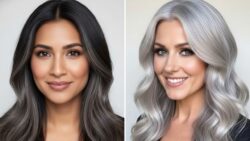
“I’m exhausted from chasing my roots,” she admits, her eyes fixed on the fine silver line running along her part. Around her, bowls of color sit on the counter like a science experiment — chestnut, espresso, iced mocha brown. Yet she isn’t choosing any of them. She wants something that doesn’t scream hair dye. Something softer. More subtle. Less… frantic.
The stylist understands. She reaches for a different chart, pointing instead to sheer tones, gentle glosses, and smartly placed lighter strands. There’s no drastic makeover and no marathon appointment. Just techniques designed to let gray hair blend in naturally, soften contrast, and quietly shave years off without announcing it.

From Full Coverage to Smart Camouflage
Step into any modern salon and you’ll hear the same request: “I don’t want it to look like I dye my hair.” People aren’t rejecting gray itself. They’re turning away from flat, solid color that looks artificial in natural light. The new aim is soft blending: allowing silver to appear, but controlling its placement and intensity.

Think transparent tints, shadowed roots, light-reflecting glosses, and scattered highlights that trick the eye. Stylists are moving away from harsh permanent dyes, opting instead for semi-permanent veils that fade gracefully. The payoff is fewer stark regrowth lines, less time in the chair, and hair that looks fresh rather than freshly colored.
When Gray Starts Looking Intentional
In a small London salon, 52-year-old Karen arrived with a familiar plea: “Make the gray disappear.” She had been coloring every three weeks, endlessly chasing a root line that seemed to race ahead. Her stylist suggested a different plan — a soft mushroom-brown glaze over the lengths, paired with ultra-fine highlights around the face and no solid root coverage.
Two hours later, the sharp line of regrowth had vanished. In its place was a smoky, dimensional shade where silver strands looked deliberate, almost like luxury balayage. Eight weeks on, the grow-out was barely noticeable. “I feel younger,” she said, “not because the gray is gone, but because I’m not fighting it every morning.”
Why Blending Flatters the Face
The logic becomes clear once you understand what gray hair does visually. A dark, opaque dye can frame the face too harshly, emphasizing fine lines and under-eye shadows. On the other hand, stark white roots against dyed lengths pull attention straight to the scalp, acting like an age spotlight.
Blending techniques soften that frame. By reducing contrast and introducing light near the face, the skin appears less tired, the jawline looks cleaner, and attention shifts back to facial features instead of the hairline.
The New Playbook for Younger-Looking Gray
The standout technique today is known as gray blending. It’s a compromise, not a battle. Instead of coloring every strand, the stylist works strategically. A translucent demi-permanent softens bright whites, while subtle lowlights add depth. Around the face, ultra-thin “baby lights” prevent heavy, blocky sections.
This method avoids rigid maintenance schedules. Without a harsh line between dyed hair and gray, appointments can stretch to eight or even twelve weeks. The beauty lies in its deliberate imperfection — slight variations in tone create that polished, lived-in look often seen on celebrities.

Low-Effort Care That Actually Works
At home, upkeep stays refreshingly simple. A purple or blue shampoo once a week keeps silver from yellowing. A lightweight oil or shine serum helps wiry grays lie smooth and reflect light instead of frizzing around the crown.
For quick fixes, tinted root sprays or powders are a quiet secret weapon. A light mist along the part before a meeting can instantly soften contrast, like a subtle filter for your hairline.
Rather than complicated routines, this trend favors small, sustainable habits: gentler shampoos, heat protection before blow-drying, and regular trims to prevent brittle ends. Over time, these details make gray hair look intentional and healthy.
A Softer Conversation With Yourself
Emotionally, this approach changes everything. You stop scrutinizing each white strand and start thinking about texture, shine, and movement. The question shifts from “Does my hair look young enough?” to “Does my hair look alive?”
Paris-based colorist Lila Moreau puts it simply: “My clients don’t ask to cover gray anymore. They ask to look rested, brighter — like themselves on a good day. The aim isn’t to deny age, but to stop letting roots speak before you do.”
Common Mistakes That Ruin the Effect
- Going too dark for coverage, which hardens facial features
- Using permanent box dye repeatedly, creating a heavy, matte finish
- Ignoring cut and shape, even with perfect color
- Overusing purple shampoo until hair looks dull
- Expecting one session to undo years of color history
A New Way to Think About Age and Confidence
When people stop chasing the illusion of zero gray, something shifts. They experiment again — with softer bangs, lighter face-framing tones, or shorter cuts that lift the neck. Friends don’t say, “Your gray looks nice.” They say, “You look rested.” That’s the real win.
The deeper change is about choice. When gray becomes a design element instead of a flaw, aging shifts from something to erase into something to edit. Keeping the years you’ve lived, while playing with light, texture, shape, and shine, is the quiet power behind this movement.