Inclusive Education
Moving From Elementary to Secondary School With Support
Make new routes, learning supports and help arrangements clear before secondary school begins.
Archive edition: 3 June 2026 · assigned for archive organisation
On this page
- At a glance
- Start with the student’s priorities
- Coordinate the handover between schools
- Understand course planning without narrowing choices too early
- Map the real school day
- Plan how help will work when something changes
- Include social participation and recovery time
- A practical example
- Common questions
- Sources and scope
Moving to secondary school often changes more than the building. A student may have several teachers, a different timetable, unfamiliar routes and new ways to obtain help. Transition planning works best when it turns those changes into a set of concrete arrangements that the student understands and can use.
This guide helps families and students prepare questions for the sending and receiving schools. Canadian school structures and course requirements vary. Ontario examples are labelled, and current school information should guide individual course, placement and support decisions.
Start with the student’s priorities
Ask what the student is looking forward to as well as what feels uncertain. They may care about joining an art club, finding friends, choosing a subject or avoiding a crowded entrance. A transition plan should preserve opportunities, not become only a list of risks and restrictions.
Offer different ways to contribute. The student could annotate a timetable, send questions in advance, select photographs of important places or speak with a trusted staff member. Avoid requiring them to describe private information in front of a large unfamiliar group.
Agree what success would look like in practical terms. “Can find a named adult when the timetable changes” is easier to plan than “will become more independent.” Independence can include knowing how to request and use support; it does not require managing every new situation alone.
Coordinate the handover between schools
Ask who coordinates the transition at each school and what information will be exchanged. Confirm which records are current, which supports need discussion and whether the student or family needs to authorize particular information-sharing. A file transfer does not guarantee that every subject teacher understands the day-to-day arrangement.
Ontario’s Policy/Program Memorandum 156 requires transition planning as part of the IEP for students who have one, with identified actions, responsibilities and timelines. It includes elementary-to-secondary transitions. This Ontario requirement should not be treated as the wording of another province’s policy.
Prepare a short handover summary focused on current participation: communication methods, access arrangements, tools, useful teaching approaches and the student’s priorities. Keep sensitive background information separate unless it is needed through the appropriate process. Ask who will check that the summary reaches the staff who need it.
Understand course planning without narrowing choices too early
Course names, prerequisites, graduation requirements and selection processes can change. Use current information from the school and ask a guidance contact to explain unfamiliar terms. Discuss how a proposed course connects with the student’s interests and future options, including what could be changed later.
The TDSB Grade 8 to 9 transition hub provides local course-planning and secondary-school resources. It is a starting point for current school-specific questions, not evidence that every course or program is available at every school. Check the actual receiving school’s offerings and deadlines.
Separate a learning goal from an access barrier. Difficulty handwriting does not by itself explain which subject interests the student or what they understand. Ask how supports and assessment arrangements will be considered alongside course choices rather than assuming that one difficulty determines the whole pathway.
Map the real school day
| Situation | Question to answer | Useful arrangement to confirm |
|---|---|---|
| Arrival | Which entrance and first destination will the student use? | A recognizable route and contact if plans change |
| Between classes | Are routes, timing and equipment access workable? | A route check and a plan for unexpected obstacles |
| Lessons | How will each teacher know the relevant support? | Clear communication and access to materials or tools |
| Lunch and breaks | Where can the student eat, rest and join others? | Options that support both access and belonging |
| End of day | How will transport or collection be confirmed? | A known meeting point and backup contact |
Visit important routes when possible. Check the actual doorway, lift access, classroom location or locker arrangement rather than assuming a general tour answers every question. If a route depends on a particular facility being available, ask what happens when it is unavailable.
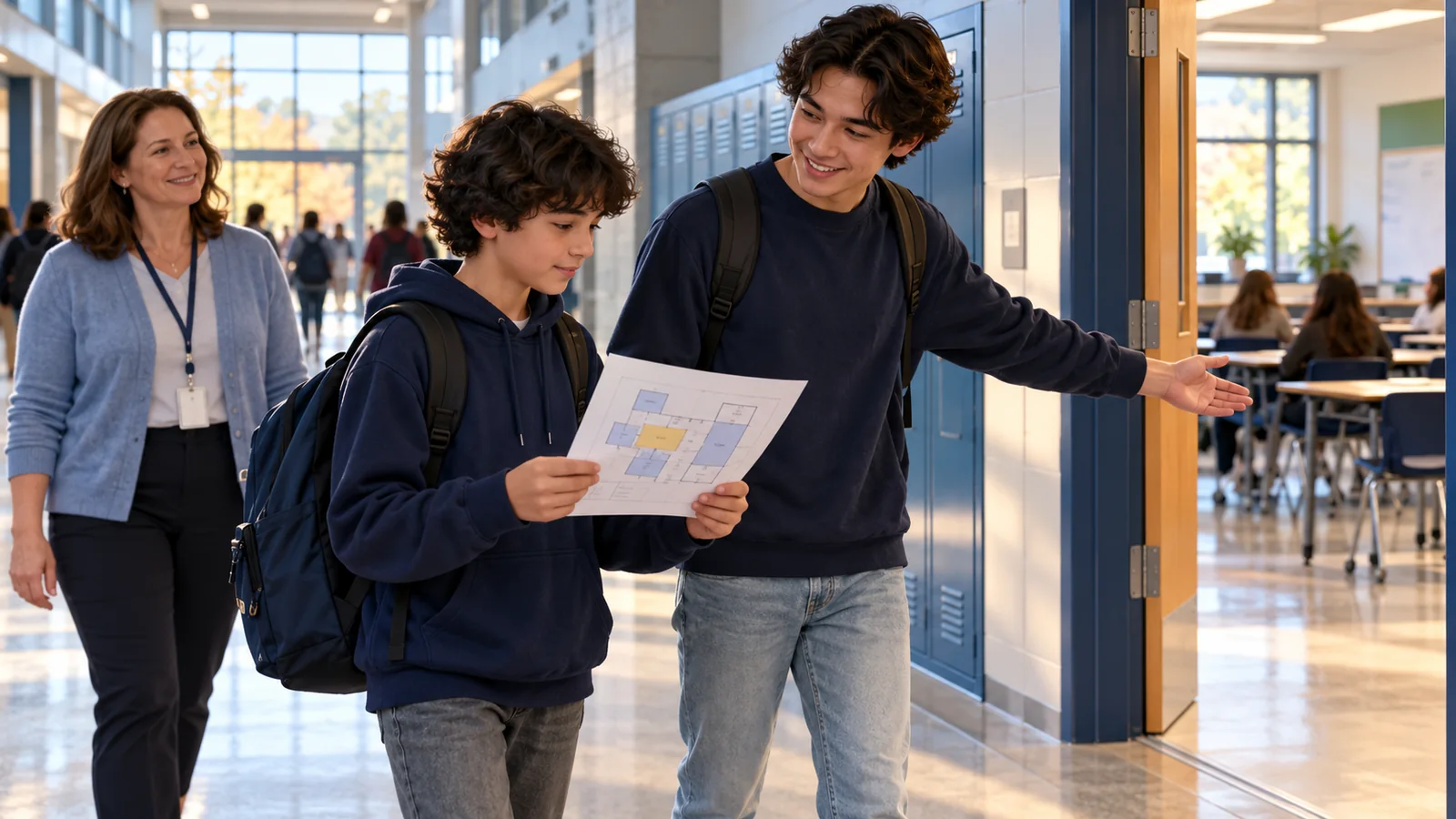
Do not make the student memorize the whole building in one visit. Start with the places needed for the first part of the day and provide a usable reference. A map can be printed, visual, digital or accompanied by another form of explanation according to the student’s preference.
Plan how help will work when something changes
A named contact is useful only if the student knows how to reach them. Ask where the person is usually available, whether an appointment is needed and who covers when they are absent. Practise the communication method the student actually uses, such as a short typed message or a help card.
Ontario’s guidance on support for students with autism includes planning for changes of classroom, grade and school. In practical terms, ask how the school will communicate a room change, supply teacher, assembly or altered timetable before it becomes a surprise where possible.
Agree how staff will respond if the student reaches the wrong room or misses an instruction. The purpose is a workable recovery plan, not a punishment for needing clarification. Also discuss how the student can report a problem privately without having to explain it in front of classmates.
- Choose priorities: identify the student’s goals and the most important changes.
- Make arrangements: connect routes, learning supports and help with named people.
- Check reality: review how the first days and weeks actually work.
Include social participation and recovery time
Ask which clubs, activities or shared interests the student would like to explore. Check the practical details: where the activity meets, how to join, what the first session involves and whom to contact about access. Do not assume that an available club is automatically accessible.
Some students want help meeting peers; others prefer time to observe before joining. Offer options without assigning a peer to speak for the student or requiring friendship as a support task. A quieter break space can be useful, but it should not become an automatic reason to exclude the student from activities they want to attend.
Consider the effort of the whole day. If the student reports exhaustion, examine routes, sensory demands, communication and workload with the team. Do not infer the cause or prescribe a reduced schedule from a generic description; seek an individualized discussion.
A practical example
In this fictional example, Aiden is excited about media studies but unsure how to manage class changes. During a short visit, he and a staff member follow the route between two rooms and identify where to ask for help. He chooses a simple map with landmarks instead of a long written explanation.
The receiving school confirms how teachers will receive the relevant support information. After the first week, Aiden explains that the route works but the lunch queue leaves too little time to eat. The review focuses on that specific barrier and possible arrangements, rather than concluding that the whole transition has failed.
Common questions
When should transition planning begin?
Ask the sending school about its current timeline and contact the receiving school early enough to discuss needs. If the move is close, prioritize essential arrangements and a prompt review.
Does the IEP automatically work the same way in secondary school?
The current plan provides important information, but implementation must be discussed in the new setting. Confirm how supports will work across subjects and teachers.
Should we attend every open-house event?
Choose useful opportunities based on the student’s needs. Ask whether a quieter visit, accessible information or a focused conversation is available if a crowded event is unsuitable.
How do we choose courses?
Use current school guidance and discuss interests, prerequisites, access and future options. Ask for explanations rather than relying on outdated course labels or another school’s timetable.
What if the student gets lost?
Agree a simple recovery plan with the school, including a known help location or contact method. The student should not need to solve an unexpected route problem alone.
Can the student keep using their communication system?
Plan how it will remain available across lessons, breaks and travel. Clarify any setup, charging, access or partner-support needs with the relevant team.
Who tells subject teachers about support?
Ask the school to identify the responsible person and process. Avoid assuming that transferring a file means every teacher has received usable information.
What if the student does not want peers told about their diagnosis?
Discuss privacy and what practical information is actually needed. Do not treat disclosure to classmates as a default requirement for receiving school support.
What should the first review cover?
Check routes, learning access, communication, breaks, peer participation and the student’s own priorities. Identify one or two concrete adjustments and who will arrange them.
Does needing help mean the transition was unsuccessful?
No. A transition plan should include how to obtain help and respond to new information. Success can involve using support reliably and participating in chosen activities.
Sources and scope
Ontario sources support the labelled policy and planning examples. The route map and fictional scenario are original editorial tools. Current course requirements, availability and individual arrangements must be confirmed with the receiving school.
- Ontario: Policy/Program Memorandum 156 — transition plans and responsibilities.
- TDSB: Grade 8 to 9 Transition — local planning resource hub.
- Ontario: Support for students with autism — planning for classroom, grade and school changes.