Inclusive Education
School Assemblies: Offering Meaningful Ways to Participate
Keep school assemblies accessible through practical choices tied to the event’s purpose.
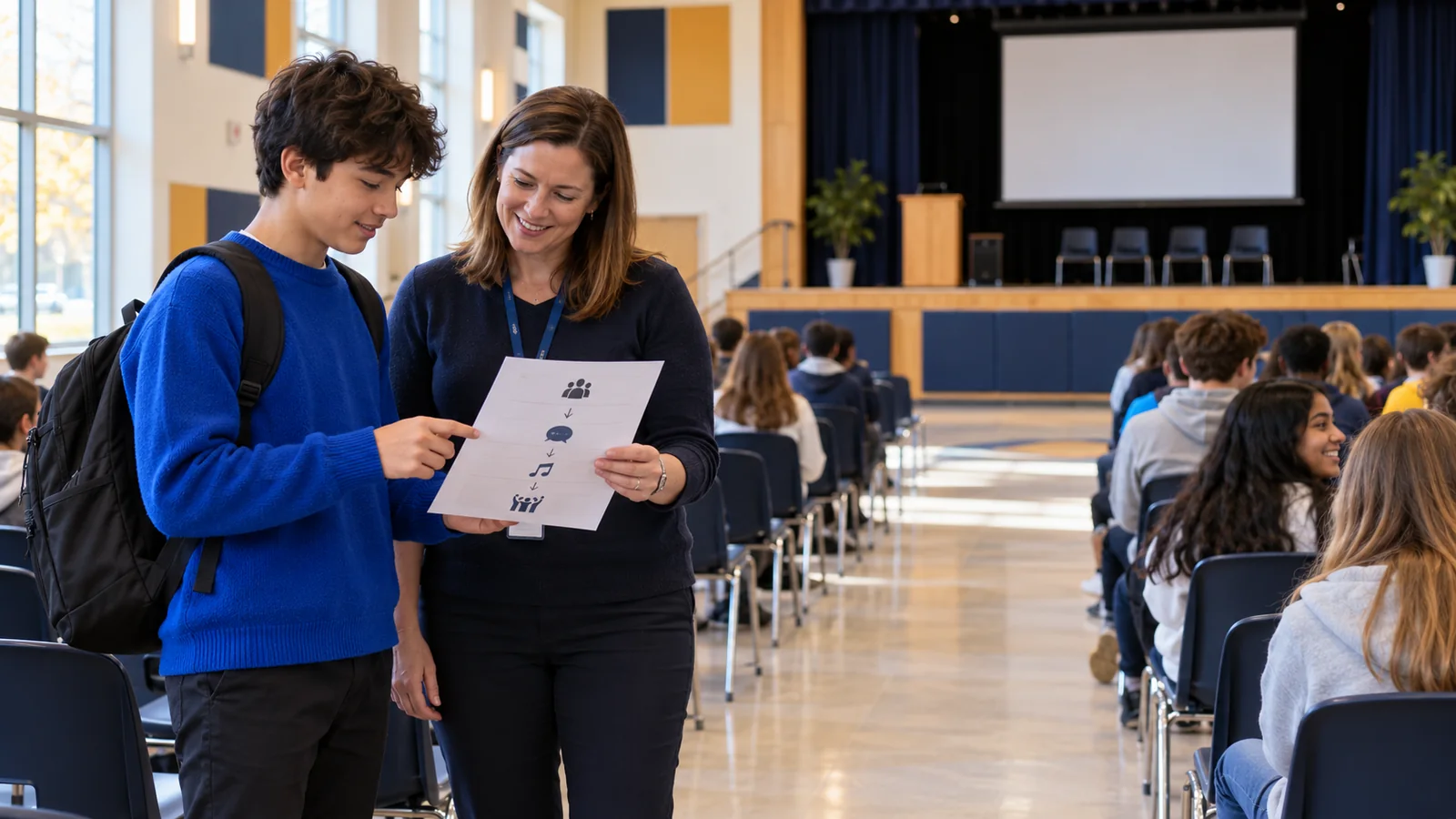
A school assembly can offer shared information, celebration and a sense of community. It can also involve a crowded entrance, unfamiliar seating, amplified sound and expectations that are not explained. Meaningful participation starts by identifying the purpose of the event and asking how the student wants to take part.
A useful plan considers access to the message, opportunities to contribute and practical choices about the setting. Attendance for the full event is not the only possible measure of inclusion. Equally, an alternative should not automatically remove a student from something they want to experience with peers.
Identify what the assembly is for
Is the event sharing important announcements, recognising achievements, presenting a performance or inviting student discussion? The purpose affects which alternatives would be meaningful. A written summary might provide announcements, but it does not automatically replace the experience of seeing a friend’s performance or receiving recognition.
Ask the student which parts matter to them. They may want to hear a particular speaker, sit beside a friend, contribute a prepared question or avoid being called onto a stage unexpectedly. Use a communication method they can access and allow time to think before the event.
CAST’s choice and autonomy guidance encourages choices that align with learning goals and acknowledges that people differ in the options they prefer. Applied to an assembly, this suggests discussing meaningful ways to participate rather than offering only the choice between full attendance and missing everything.
Make the event sequence visible
Share a short outline: where students gather, how they enter, where they sit, the main sections, approximate duration and what follows. Say what is confirmed and what may change. If the event includes a loud performance, audience response or a surprise announcement, consider whether relevant advance information can be provided without spoiling the event for everyone else.
A simple written sequence, explanation or visit to the hall may help some students. Others already know the space and only need the changed details. Avoid making preparation into a lengthy compulsory rehearsal; ask what information the student actually wants.
Explain participation expectations directly. Does the audience answer questions aloud? Can students remain seated? How are volunteers chosen? Students should not have to infer all of this from others while also processing the event.
Review the physical setting
Consider the route, crowding, seating, lighting, speakers and available support. The best seat depends on the student: distance from a speaker, a clear view, space for equipment or proximity to a trusted person may matter more than simply being at the front or back.
The North Lincolnshire school autism toolkit discusses the effect of sound, preparing for demanding environments such as halls and adapting seating relative to noise sources. Its sensory examples can inform a conversation, but the toolkit’s UK setting and wider teaching approaches should not be imported wholesale into a Canadian student’s plan.
If hearing protection or another familiar support is considered, check the student’s preference and how important information remains accessible. Do not assume that equipment alone resolves the environment. Staff should also examine avoidable noise, crowding and unclear communication.
Offer practical participation options
| Barrier or preference | Possible option | What needs confirming |
|---|---|---|
| Crowded arrival | A planned entry time or route | Supervision and where the student meets the group |
| Unclear spoken information | A usable written outline or captioned content | Access before or during the relevant section |
| Only one section is wanted | Agreed partial participation | Timing, transition and the rest of the programme |
| Speaking live is a barrier | A prepared contribution in another format | How it will be presented and credited |
| A break may be needed | A known request method and suitable space | Responsible staff, return and access to missed information |
These are prompts, not guaranteed arrangements. Confirm staffing, available technology and relevant school procedures. A plan that relies on a room, adult or live stream must check that those things will actually be available.
Make the information accessible in more than one way
CAST’s guidance on perceiving information explains why sound-only and visual-only presentations can create barriers. It gives examples such as text equivalents for speech and descriptions of important visuals. For an assembly, examine both the speaker’s message and any information contained in slides, images or demonstrations.
A slide deck filled with small text is not automatically an accessible alternative to speech. Check readability, timing and whether the student can use it in the needed format. Similarly, a recording may require captions or another way to understand visual information. A brief accessible summary can help with key announcements, but discuss what it leaves out.
If a student contributes a recording, written message or other prepared material, agree how it will be used and who will see it. Do not treat permission to present at one school event as permission to post it publicly online.
Agree on breaks and transitions
- Before: Share the sequence and agree on options.
- During: Make information, help and chosen participation accessible.
- Pause: Use an agreed break route when needed.
- After: Reconnect with the class and review the experience.
Clarify how the student can request a break without a public explanation. Identify where they will go, who is responsible and whether returning is possible. A break should not become an argument at the doorway because relevant staff did not know the plan.
Plan the end as carefully as the entrance. A large crowd leaving at once may be the most difficult part. Explain where the next activity is and how changes will be communicated. Ensure the student’s usual equipment or communication system remains available during the transition.
Review participation, not endurance
After the event, ask what the student could access and what they would change. Did they receive the information, see the section they wanted or contribute in the agreed way? Was the seating useful? Did staff respond to a request? Consider effort and comfort alongside visible attendance.
If the student missed an important element, discuss how to provide it and what to change next time. Avoid assuming that staying longer is always the next goal. A shorter, chosen and well-supported experience may be more meaningful than remaining in a room without being able to follow what happens.
Common questions
Does inclusion require attending the entire assembly?
Not necessarily. Start with the event’s purpose and the student’s preferences, then discuss meaningful participation options. Partial attendance or another format may help, but should not automatically replace an event the student wants to join. Check what information, recognition or shared experience each option provides.
Should the student always sit near an exit?
No single seat suits everyone. Discuss sight lines, sound, space, peers and access to support. A seat that makes leaving easier may still be too close to a speaker or far from a needed view. Confirm the actual location with the student where possible.
Can a written summary replace every assembly?
It may convey announcements, but cannot necessarily reproduce a performance, discussion or shared celebration. Identify what the student wants from the event and what the alternative would miss. Use the summary as part of an access plan rather than assuming it is equivalent in every case.
What if the student does not want to speak live?
Discuss a prepared written, recorded or other accessible contribution where appropriate. Confirm how it will be presented and credited, and whether the student wants their name used. The alternative should serve the activity’s purpose without making spontaneous speech the only route to participation.
Should hearing protection be required?
No. Ask about the student’s preference and any existing support arrangements. Consider how they will receive important information while using it. Environmental changes may still be needed; equipment should not become the sole response to avoidable noise or a reason to ignore other barriers.
How can a break request be made discreetly?
Use an agreed communication method familiar to the student and relevant staff. Confirm the destination, supervision and return plan beforehand. A signal is only useful if someone notices and responds, so include the people managing the event rather than relying on one teacher’s understanding.
What if the assembly changes at short notice?
Tell the student which parts have changed and revisit any affected arrangement. Keep a practical backup for seating, timing or support. Do not promise that every surprise can be removed, but avoid leaving the student to discover important changes only after entering the hall.
Can a contribution be shared online afterward?
Check the school’s consent and privacy process and the student’s wishes. Agreement to contribute to a particular event should not be treated as automatic permission for wider publication. Clarify the audience and use before collecting or distributing a recording or image.
How do we avoid alternatives becoming exclusion?
Ask whether the student chose the option, can access the purpose of the event and still has opportunities they value. Review repeated separation from peers or recognition. An alternative should address a barrier while preserving meaningful participation, not simply make event management easier.
What should we ask afterward?
Ask what the student could follow, enjoy or contribute to, and which arrangement helped or failed. Include their account of effort and comfort. Attendance duration alone cannot show whether the event was accessible or whether the next assembly should use the same plan.
Sources
CAST learning-design guidance and the relevant sensory sections of a UK local-authority school toolkit checked on 22 October 2026. Practical options require agreement with the Canadian school; no universal attendance or accommodation rule is asserted.