Assistive Technology
AAC Explained: Communication Boards, Apps and Speech-Generating Devices
Explore communication options that fit the person, their messages and everyday situations.
Archive edition: 23 August 2026 · assigned for archive organisation

Communication can include speech, typing, gestures, pictures, writing and other ways of expressing a message. Augmentative and alternative communication, usually shortened to AAC, brings these possibilities into a person’s communication support. It may add to speech, provide another way to communicate or be used at particular times.
The important question is what someone wants to communicate and how they can do so in the settings that matter to them. A tablet is one possible tool, not the definition of AAC. This introduction explains common terms and questions to take to a speech-language pathologist or AAC service. It does not prescribe a system for an individual.
What the terms mean
The Communication Health Support Association’s AAC introduction, linked from ASHA, explains that augmentative communication adds to speech, while alternative communication can be used instead of speech. It describes options ranging from gestures and writing to apps and speech-generating devices. Someone may combine methods during the day.
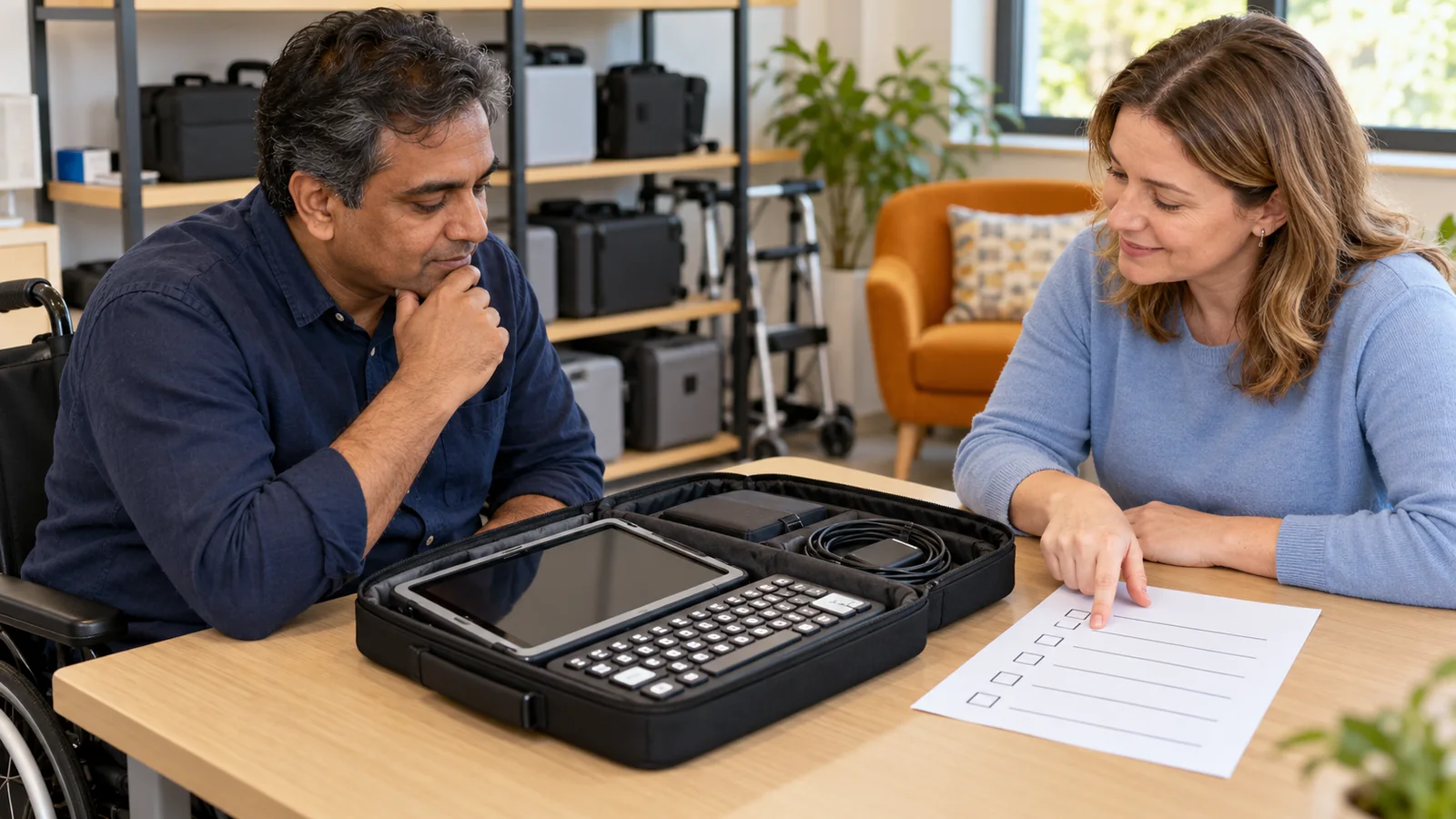
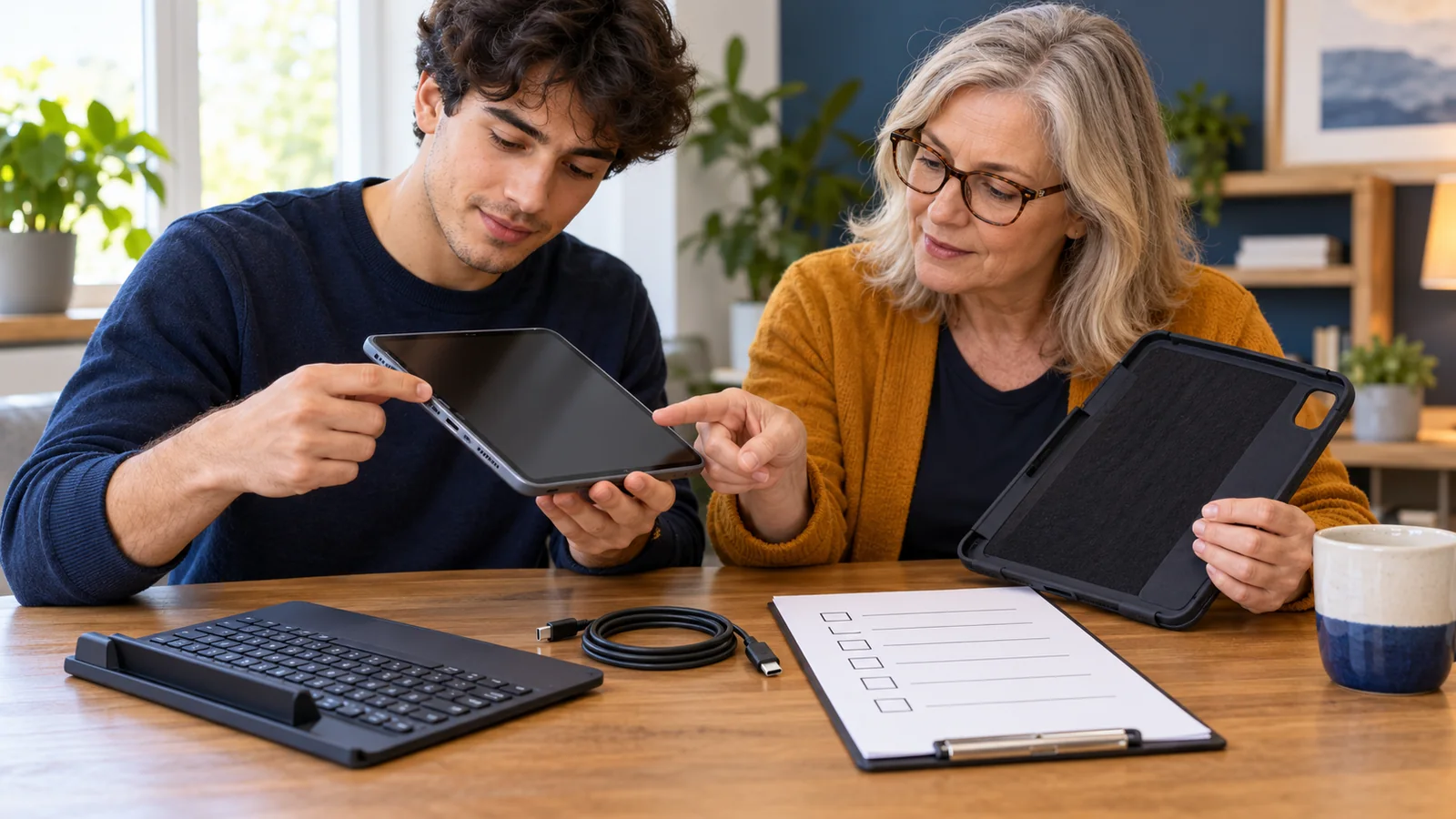
A communication board displays words, letters, images or other symbols on a surface. A communication book offers more than one page. A speech-generating device produces audible output after the user selects or composes a message. An app may provide communication functions on a general-purpose tablet or phone; dedicated hardware may provide additional access or durability features.
These descriptions do not establish a ladder from “simple” to “advanced” people. A paper board may be useful in one setting while a device is preferred elsewhere. The complexity of the tool does not tell you how much a person understands, what they want to say or whether they have something important to contribute.
Compare what different tools make possible
| Option | What to investigate | Practical question |
|---|---|---|
| Communication board or book | Vocabulary, layout, page access and partner understanding | Can the person find and indicate the messages they want? |
| Text-based communication | Typing or spelling access, display and optional speech output | Does the input method work comfortably in the intended setting? |
| Symbol-based app | Vocabulary organisation, access settings and personalisation | Can it support more than a small set of requests? |
| Dedicated speech-generating device | Access options, positioning, portability and maintenance | Can the person use it across the places they need to communicate? |
| Combined methods | How tools and familiar communication work together | Do partners respond consistently when the method changes? |
Ask what happens when a desired message is not on the first screen or page. Can the person introduce a new topic, disagree, ask a question, make a joke or correct a misunderstanding? A demonstration focused only on asking for an object can leave important communication purposes unexplored.
Consider who will hear or see the message. A written message may work well with a person who can read it, but require another arrangement across a room or in a noisy environment. Instead of assuming one tool must do everything, identify where additional options would be useful.
Speech and AAC can coexist
The National Joint Committee’s AAC overview explains that people may use AAC when speech is unreliable some or all of the time, and that having speech does not rule out AAC support. It also rejects fixed prerequisite skills for beginning AAC consideration. These are communication principles, not a determination of eligibility for a Canadian funding programme.
Someone might speak in a familiar setting and prefer typing during a demanding conversation. Another person may use a communication book with a familiar partner and a device with someone new. Ask what is useful in the current situation rather than insisting on the method an observer thinks should be easiest.
If you are a communication partner, allow time for the message. Do not demand speech first or turn every interaction into a test of using the device. If you are unsure what was communicated, say what you understood and invite correction through the person’s preferred method.
What assessment and ongoing support can cover
A useful discussion looks beyond the product. Ask about language, vision, hearing, movement, positioning, literacy, preferred activities and communication partners. Explain where communication is currently working and where it breaks down. Include the person’s own priorities in an accessible way.
Holland Bloorview’s Communication and Writing Aids service overview describes team assessment, goal setting, consultation and training in specialised communication systems. This Canadian service example shows that provision can involve more than handing over equipment. Its page does not establish access to that service for every reader; ask the relevant local programme about referral and eligibility.
Before purchasing, discuss a trial where available. Ask what will be explored, who will configure the tool, how partners will learn to use it and how observations will be reviewed. A person’s response to an unfamiliar device in one short appointment should be described with context, including what support and learning opportunities were available.
- Listen. Identify the communicator’s priorities and current methods.
- Explore. Compare tools and access methods with appropriate support.
- Use. Make communication available in meaningful everyday situations.
- Review. Ask what is working, what is missing and what needs to change.
An everyday example
In a fictional example, Alex wants to participate in a community cooking group. A small board supports quick comments about ingredients, but it does not contain the story Alex wants to share about a family recipe. Alex uses a text-based option for the longer message. The group waits and responds to the story rather than praising the mechanics of using the tool.
The example is not a recommendation that every person needs those two systems. It illustrates a useful planning question: does the arrangement allow the person to say something beyond what other people predicted? Review missing vocabulary, access difficulties and partner behaviour instead of interpreting every communication breakdown as a lack of ability.
Plan for practical access too. A device in a locked cupboard or a board stored beyond reach cannot serve its purpose at that moment. Agree on who helps with setup, charging or transport when assistance is wanted, while respecting the communicator’s control over their messages and private information.
Common questions
Is AAC only for people who never speak?
No. The professional overview cited above includes people who use speech and need another method in some situations. Describe when speech meets the person’s needs and when it does not. A speech-language pathologist can help explore options without requiring one method to replace every other one.
Is an AAC app the same as a speech-generating device?
An app can provide speech output on a phone or tablet, while a dedicated device combines communication software with particular hardware features. Compare the complete arrangement, including access, portability and support. The label alone does not tell you whether it will work for a person.
Does someone need to prove readiness before asking about AAC?
The NJC overview does not support fixed prerequisite skills for beginning AAC. Ask for an assessment of access and communication opportunities rather than a vague judgement of readiness. Any specific service or funding criteria should be explained separately from the person’s need to communicate.
Are picture boards only for children?
Choose content and presentation that fit the person, language and setting. Avoid childish imagery merely because a person uses symbols. Ask whether the available vocabulary represents their actual interests, relationships and responsibilities, and whether they can add or request missing messages.
What if a person prefers a gesture to using the device?
Respond to the communication and keep other options available. The quickest or most comfortable method can vary by situation. If the gesture is unclear, invite clarification rather than refusing to respond until the person uses a preferred adult-selected tool.
Can we choose a system from an online recommendation?
A recommendation can identify an option to investigate, but it cannot replace checking the person’s access, language and everyday needs. Ask what a reviewer actually tested and whether a trial is possible. Avoid assuming a popular product will suit every communicator.
Who should learn about the system?
Ask the communicator which people need practical support to communicate with them. Family, educators, support workers or colleagues may need different information. Training should help partners listen and respond, not give everyone unrestricted access to private messages or editing controls.
What if the first tool does not seem useful?
Describe what happened before concluding that AAC itself is unsuitable. Consider access, vocabulary, setup, partner support and the opportunity to learn. Bring specific observations to the relevant professional so the next decision addresses the actual difficulty rather than simply replacing one product with another.
Should communication be limited to requesting needs?
Ask how the system supports relationships, questions, opinions, refusal and topics the person chooses. Requests are only one part of conversation. Review whether the available vocabulary and partner responses leave space for messages that are unexpected or inconvenient.
Where can Canadian readers begin?
Look for a speech-language pathologist or local AAC service and ask about referral, age range, assessment and trial options. School, rehabilitation or community routes may differ. Confirm the actual service criteria rather than assuming that a named programme in another region can accept a referral.
Sources
Primary professional and service pages opened and checked on 21 October 2026. This is a general introduction, not an individual clinical assessment. No product was tested or endorsed; the Alex example is fictional.
- Communication Health Support Association: Augmentative and Alternative Communication — public introduction linked from ASHA.
- National Joint Committee, hosted by ASHA: AAC — multimodal communication and consideration principles.
- Holland Bloorview: Communication and Writing Aids virtual tour — Canadian service overview.