Inclusive Education
Music Classes: Exploring Sound, Instruments and Participation Choices
Plan music learning around student interests, clear cues and usable participation options.
On this page
- At a glance
- Find the learning goal behind the activity
- Understand the sound environment
- Make the lesson sequence predictable
- Check instruments and participation options
- Present musical information in usable formats
- Keep participation connected to music-making
- Review the lesson with the student
- Common questions
- Sources
Music class can involve listening, creating, singing, playing instruments and working with others. An autistic student may enjoy some of these experiences and find others difficult to access. Begin with their interests and the lesson’s learning goal, then examine sound, instructions, equipment and participation choices.
Do not assume that autism means exceptional musical ability, a dislike of sound or a need for music therapy. This guide concerns access to school music education. It offers questions for students, families and teachers, not treatment claims, hearing advice or a promise that one instrument will suit everyone.
Find the learning goal behind the activity
Ask what the class is learning: recognising a pattern, keeping a pulse, exploring musical expression, composing, listening critically or coordinating an ensemble. Knowing the goal helps distinguish an essential element from a teaching method that could be adjusted.
For example, a student might demonstrate understanding of a repeating pattern through an instrument, a digital sequence or another agreed representation, depending on the curriculum goal. That does not mean every format is equivalent for every task. Discuss the specific learning and assessment with the teacher rather than assuming an alternative automatically meets it.
Include the student’s musical preferences. They may want to explore a new instrument, work with a friend, listen before joining or create a piece privately before sharing it. A preference should guide the discussion without becoming a permanent limit on opportunities.
Understand the sound environment
Ask about the difference between one instrument and several playing together, expected and unexpected sounds, background noise and the position in the room. The student may enjoy music while finding a particular classroom arrangement uncomfortable. Avoid interpreting a request for a quieter setting as lack of interest.
The Musicians’ Union’s neuro-inclusive teaching guidance includes providing lesson structure in advance and considering distractions such as background noise and movement. These are practical teaching ideas from a UK professional organisation, not evidence that all neurodivergent learners share the same needs.
Discuss whether fewer simultaneous sound sources, a different position or clearer start-and-stop cues would help. Changes to amplification or hearing protection should be handled through appropriate school guidance and any relevant professional advice. Do not use this article to set a supposedly safe volume or prescribe equipment.
Make the lesson sequence predictable
- Preview: Explain the goal, instruments and order of activities.
- Explore: Offer an appropriate way to try the task and ask questions.
- Create: Support the agreed musical contribution.
- Review: Ask what helped and what needs changing.
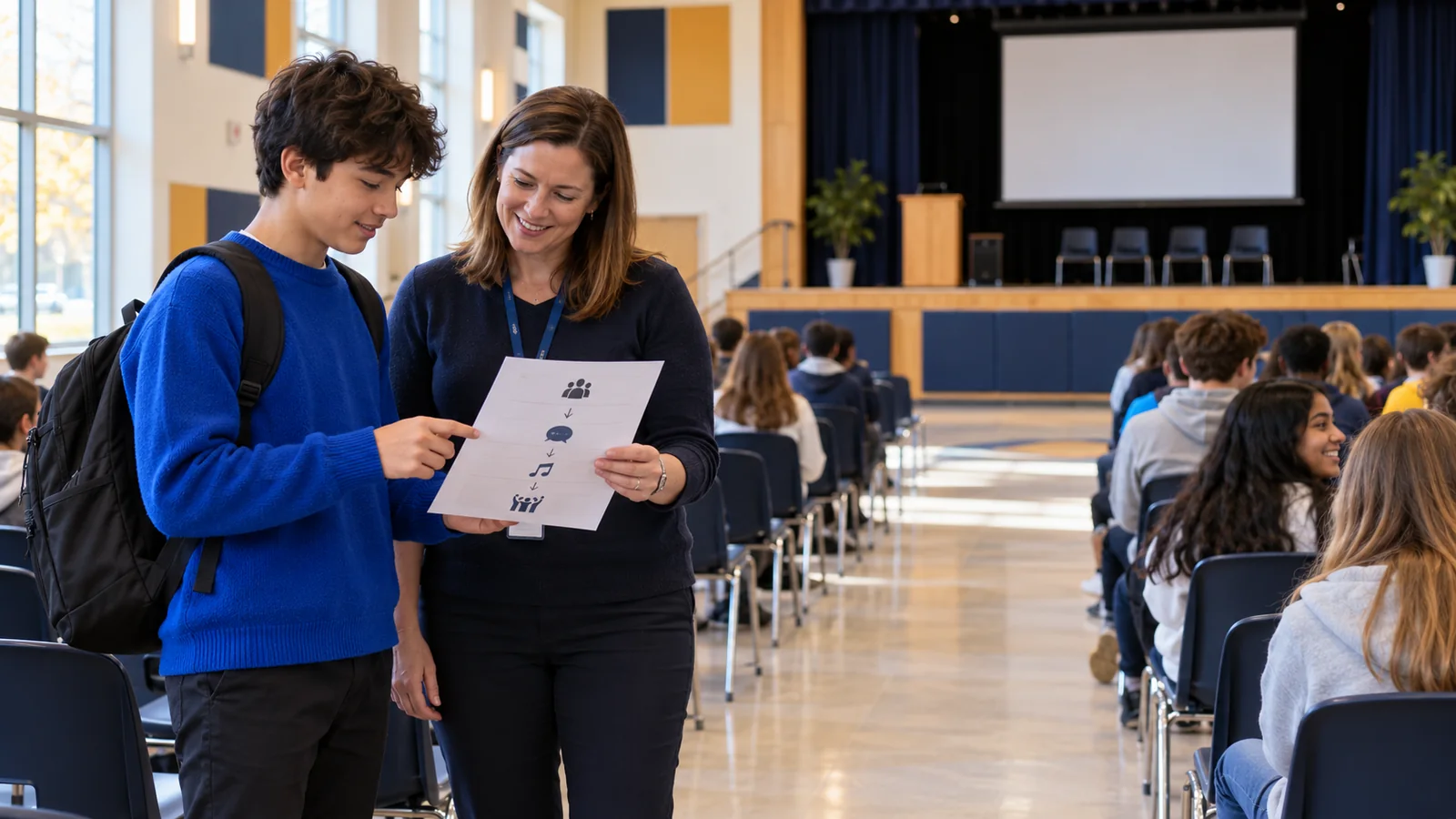
A short outline can identify when students listen, practise, play together and pack away. Explain what a cue means before relying on it. If raising a hand means stop playing, make sure the student can see the cue and understands the response. Do not assume they will work it out while several instruments are sounding.
Agree on how to ask for a pause or clarification. The request method should remain available during the activity, including when speech is difficult or the room is loud. Clarify what happens during a break and how the student can rejoin without a public explanation.
Check instruments and participation options
| Area | Question to ask | Option to explore with the teacher |
|---|---|---|
| Instrument access | Can the student reach, hold or operate it comfortably? | An appropriate position, support or alternative interface |
| Instructions | Can the student understand the task before playing begins? | A demonstration and usable written or visual sequence |
| Sound | Which features of the activity create difficulty? | Different spacing or fewer simultaneous sound sources |
| Group work | Are the role and entry cues clear? | An agreed part with accessible signals |
| Sharing work | What audience and format does the student prefer? | A small-group, recorded or other agreed presentation |
Check an alternative with the actual task. A digital instrument may offer useful access, but a device’s presence does not establish that its controls are usable or that it meets the learning goal. Likewise, an adapted position should be assessed by the appropriate staff rather than improvised physical assistance.
UK music charity Live Music Now describes Count Me In! as an approach to group music-making with varied learners, supported by songs and resources. Its programme overview is an example of inclusive ensemble planning, not proof of a guaranteed benefit or a recommendation to buy a particular resource. We have not evaluated the full programme.
Present musical information in usable formats
CAST’s guidance on multiple ways to perceive information includes alternatives for auditory and visual content, including musical notation and descriptions. For a music lesson, ask which features of the information the student needs to access and how the format can support them.
A diagram can clarify the order of a pattern, but only if its symbols are understood. A spoken explanation may help one student and be difficult for another to retain. Introduce the chosen representation and check understanding rather than adding more formats without a clear purpose.
For recorded material, examine captions, descriptions and the ability to pause or revisit relevant information. Some musical details may need a teacher’s explanation beyond ordinary speech captions. Ask how the student’s existing communication or assistive technology can be used in the lesson.
Keep participation connected to music-making
Watching or listening can be a meaningful part of music learning, especially when it serves an agreed goal. But if a student is repeatedly assigned only to observe while others create and perform, review the pattern. Ask whether barriers have been addressed and whether the student wants a more active contribution.
Group roles should be understandable and valued. A short repeated part can be musically important; complexity is not the only measure of contribution. At the same time, do not assume a student always wants the simplest role or cannot develop further skills.
Check consent and school procedures before recording or sharing work. Permission to practise a piece in class does not automatically cover posting a performance online. Explain the intended audience and use in a format the student can understand.
Review the lesson with the student
Ask what they could understand, create or contribute to, and which part took unnecessary effort. Did they know when to begin? Could they request a pause? Was the instrument accessible? Did they have a role they wanted? Staff observations are useful alongside the student’s own account.
Change one practical element where possible and check whether it helps. Revisit arrangements when the class moves from individual practice to an ensemble, introduces a new instrument or prepares for a performance. The aim is access to meaningful musical learning, not simply remaining quiet in the room or tolerating more sound.
Common questions
Are autistic students always especially musical?
No. Interests, experience and abilities vary. Start with the individual student’s preferences and learning rather than a stereotype about talent. A student should be able to explore music without pressure to demonstrate exceptional ability, and should not lose access because they are a beginner.
Does sensitivity to sound mean music class is unsuitable?
Not automatically. Identify the particular sounds, timing and environment involved, and ask what the student wants to do. A person may enjoy music but find many instruments playing unpredictably difficult. Discuss appropriate access changes rather than assuming either complete avoidance or forced participation is necessary.
Should everyone use the same instrument?
That depends on the learning goal and teaching plan. Ask which features of the instrument are essential and whether another suitable option can demonstrate the intended learning. Alternatives should be assessed for access and purpose, not chosen solely to keep the student occupied separately.
Can digital instruments help?
They may offer a useful interface for some learners, but should be checked with the actual student and task. Consider controls, sound settings, device access and the learning goal. A digital option is not automatically accessible, and this guide does not recommend a particular product.
How can a student request a pause in a noisy room?
Agree on an accessible method before the activity, such as a familiar signal, written message or communication device. Make sure the teacher can notice and respond. Explain where the student can pause and how to rejoin without needing to justify the request publicly.
Are captions enough for every music video?
Not necessarily. Captions may convey speech but omit relevant musical or visual information. Ask what the lesson requires the student to understand and whether descriptions, notation, another representation or teacher explanation are needed. Check the actual media rather than relying on an accessibility label.
Is listening instead of playing always exclusion?
No. Listening can be an important musical activity when it has a clear purpose and fits the student’s choice. Review repeated observation-only roles, however, to ensure unresolved barriers are not preventing opportunities to create, practise or contribute in ways the student wants.
Does school music class count as music therapy?
No. Music education and music therapy have different purposes and professional contexts. This guide concerns access to curriculum learning and participation. It does not claim that a classroom activity treats autism, improves a clinical condition or replaces individual professional support.
Can a performance be recorded and shared?
Follow the school’s consent and privacy procedures and discuss the student’s wishes. Clarify the audience and use before recording. Agreement to take part in a classroom activity should not be treated as automatic permission to distribute an identifiable recording more widely.
How should progress be reviewed?
Connect the review to the agreed learning goal and the student’s experience. Ask whether they could understand the task, use the instrument or format and make a meaningful contribution. Time spent in the room or apparent tolerance of sound alone does not demonstrate accessible learning.
Sources
Professional music-teaching guidance, a programme’s own overview and CAST learning-design guidance checked on 22 October 2026. Programme claims are not treated as tested outcomes, and no music-therapy or product endorsement is made.