Inclusive Education
Requesting Classroom Sensory Adjustments: A Conversation Guide
A practical conversation guide for students, families and educators: describe the barrier, agree on a change and review what helps.
Archive edition: 4 June 2026 · assigned for archive organisation
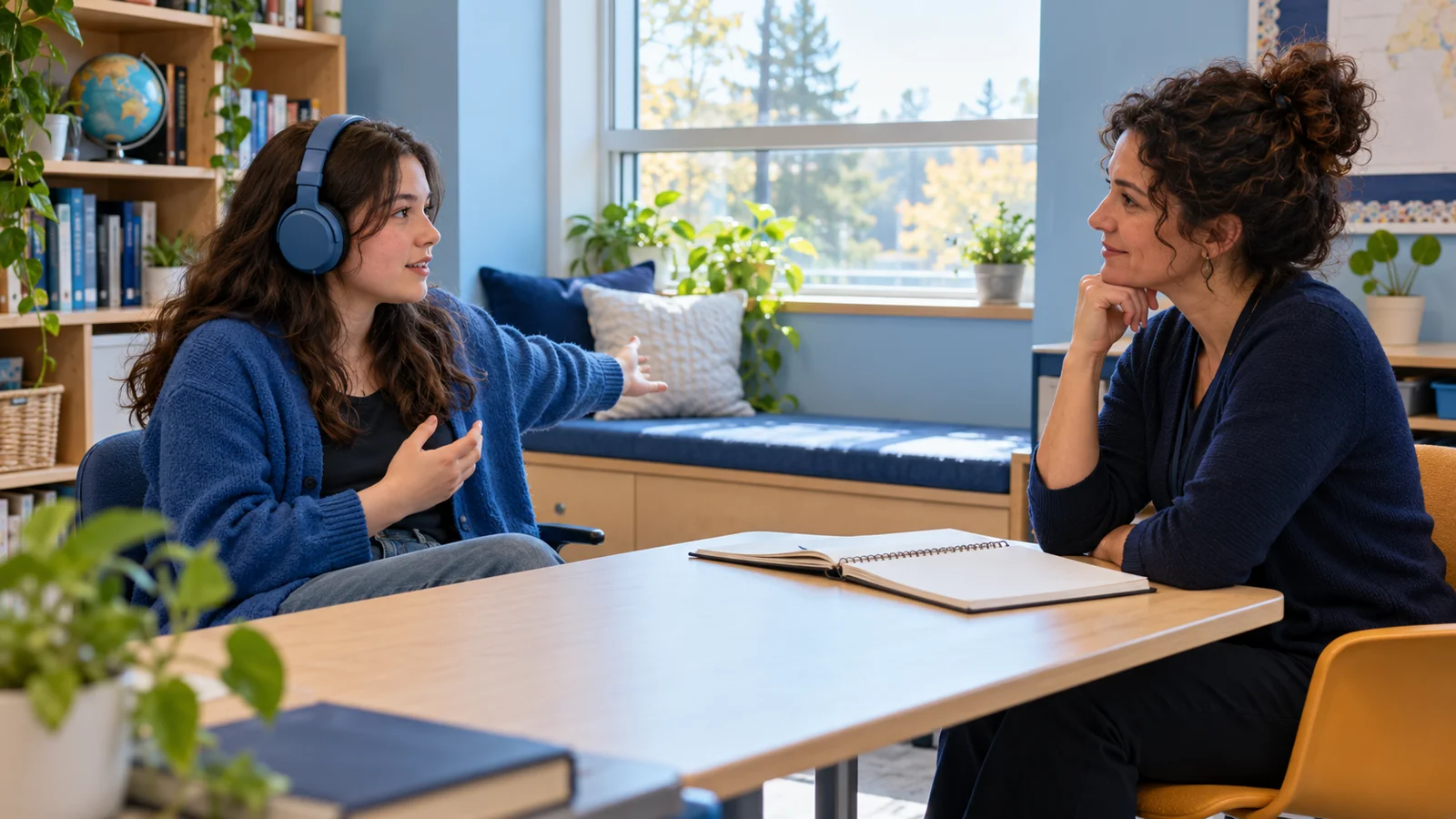
A useful request for classroom sensory adjustments starts with a specific experience: what the student finds difficult, when it happens, and what they would like to try. You do not need to arrive with a shopping list of specialist equipment. A short conversation about one part of the day can give the school team a clearer starting point than a broad request to make everything “sensory friendly”.
This guide offers an original planning worksheet and conversation examples for students, families and educators in Canada. The examples are suggestions for discussion, not a prescribed intervention or a statement of legal entitlement. School procedures differ by province, territory and school board. British Columbia resources are identified where used; UK sources inform the sensory background, not Canadian rules.
At a glance
- Describe a particular situation and ask the student what would make participation easier.
- Agree on a small, clearly defined change, who will arrange it and when to review it.
- Record comfort and access to learning, rather than treating quiet behaviour as the only sign of success.
- Check the school’s local planning process before assuming that a particular document or purchase is required.
Start with the student’s experience
Sensory experiences vary between people and can change with context. A sound, light or texture that one student enjoys may be uncomfortable for another. Autism Central’s explanation also notes that factors such as sleep, emotional state and the surrounding environment can affect how sensory information is experienced. That is a reason to ask about a particular day or setting, rather than assuming that one permanent label explains every response. Read the sensory background from Autism Central.
Choose a calm time to ask about school. Offer more than one way to respond: conversation, typing, drawing on a classroom map or selecting from a few written options. If the student does not want to discuss the experience immediately, arrange another time. A parent’s observation is useful, but mark it as an observation rather than presenting it as the student’s own explanation.
An opening question could be: “Which part of science class feels hardest to work in?” Follow with something concrete, such as whether the difficulty occurs during instructions, group work or clean-up. Avoid leading the student towards a preferred answer. “Do you want a quieter seat?” is more useful after hearing their description than before it.
Describe the situation without guessing the cause
Prepare two or three brief examples. Write down where the student was, what was happening and what they said or did. Keep the record proportionate. The purpose is to support a conversation, not to create constant surveillance of the learner or collect private information about classmates.
For example, “During group work on Tuesday, chairs scraped repeatedly and I could not follow my partner’s instructions” gives the team a situation to discuss. “The student refuses group work” adds an interpretation while losing the environmental detail. If you do not know why something happened, write “cause unclear” and ask the student and teacher what they noticed.
A short preparation note
- Activity: the lesson or routine the student wants to access.
- Barrier: the specific difficulty, in the student’s words where possible.
- Existing help: something already tried, including whether it helped only sometimes.
- Proposed next step: one question or small change to discuss.
- Follow-up: a suggested review date and a way for the student to comment privately.
A three-step conversation
- DescribeBring one situation, the student’s perspective and the learning activity they want to access.
- AgreeWrite down the proposed change, the staff member arranging it and a practical start date.
- ReviewAsk whether the change helped, introduced another difficulty or needs adjusting.
At the meeting, separate the aim from the tool. The aim might be hearing instructions during a practical lesson. A different seat, written instructions or a change to how the task is introduced are possible discussion points; purchasing headphones is not the only imaginable response. Ask the teacher what can be arranged within that particular room and timetable.
Use the end of the conversation to remove ambiguity. “We will support sensory needs” is difficult to follow up. “The teacher will offer the side table during independent writing, explain how to choose it, and check in with the student next Friday” identifies an action and a review point. This is an illustrative record, not a recommended arrangement for every student.
Options to discuss with the school
HealthyMinds BC’s educator resource recommends individualising sensory strategies with the student and their support team. It includes changes to lighting, visual clutter, noise, seating and access to breaks. These are options to consider, not a package that every classroom or learner needs. See the HealthyMinds BC sensory-processing resource, pages 3–4.
| Situation to describe | Question to discuss | Detail to record |
|---|---|---|
| Instructions are difficult to follow during a noisy activity | Could the instructions also be available in a written or visual format? | Where the student will find them and who updates them |
| A usual seat feels uncomfortable | Could the student compare two suitable places to work? | How to choose, and whether both places provide access to teaching |
| A large event feels overwhelming | What ways of participating could be planned before the event? | The student’s preference, supervision and access to the activity |
| A break is needed but asking is difficult | Could the student use an agreed signal or written request? | Who responds and what happens if the usual staff member is absent |
The National Autistic Society offers examples including quieter lunch arrangements, reducing chair noise and planning access to a calm space. Its article discusses UK law, so those legal references should not be applied as Canadian requirements. The practical examples can still help you formulate a question for your own school. Explore the National Autistic Society’s classroom examples.
Record the agreement and review participation
Send or keep a short summary after the conversation: the agreed action, the person responsible, the start date and the review date. Ask how it will be shared with relevant staff without circulating unnecessary personal details. Where the student moves between classrooms, clarify whether the agreement applies in one room or several.
Choose a few questions for the review. Could the student get the instructions? Did they use the option comfortably? Was the arrangement available when needed? Did it make joining the activity easier? Ask the student separately if a group discussion would make it difficult to speak honestly. A student sitting silently is not, by itself, enough information to judge whether the arrangement works.
If the trial did not help, describe what happened before replacing it with a more complicated plan. Perhaps the option was not actually available, the instructions were unclear or a different difficulty emerged. Distinguishing these possibilities makes the next conversation more useful. It also avoids treating an unsuccessful trial as a failure by the student.
Check the local process and the limits of this guide
Ask the school which planning document and staff contact apply. British Columbia’s inclusive-education resource page brings together its current policy manual and ministerial orders. It is a useful starting point for BC families, but it does not establish the procedures used in another province. Find BC’s inclusive-education policies and resources.
This conversation guide does not diagnose sensory difficulties, prescribe treatment or decide which equipment is suitable. If a proposed change raises a health or safety question, ask the school which qualified professional should help assess it. Keep urgent health concerns separate from routine classroom planning. Do not wait for a scheduled review meeting to raise an immediate safety issue through the school’s appropriate channel.
Common questions
Do I need a finished sensory profile before speaking to the teacher?
You can begin by describing a concrete difficulty and asking how the school usually gathers information. Do not postpone a useful conversation simply because your notes are informal. The team can explain whether an existing assessment, planning document or another professional’s input would help with the particular request.
What if the student cannot explain the difficulty in spoken words?
Offer a communication method the student already uses comfortably, and allow time. You might ask whether a photo of the room, a written choice or a simple map would help. Distinguish the student’s expressed choice from an adult’s interpretation. An observation can start a question without becoming a definitive explanation.
Should I request headphones immediately?
Start with the task and the student’s preference, then discuss tools. Ask how any proposed headphones would be used alongside instructions, communication and safety arrangements. A product purchase should not replace a clear agreement about the difficulty being addressed. This guide does not assess or recommend a particular device.
How detailed should my written request be?
A short note is often easier to discuss than a long account containing several unrelated concerns. Include the situation, the student’s description, one or two questions and a way to arrange a conversation. Keep any longer records available if the team needs them, and avoid including private information about other children.
What if the teacher notices something different from what we hear at home?
Record both accounts without deciding that one must be wrong. Ask which part of the day each person is describing and whether the student can add context. Agree on a specific question to investigate together. Different observations are a reason to clarify the situation, not a reason to dismiss the concern.
Can an adjustment be tried in just one lesson?
A clearly bounded trial may help the team understand a particular situation. Write down its scope so everyone knows where the arrangement applies. Also ask whether the student anticipates a similar difficulty elsewhere. A limited trial should not be mistaken for a complete assessment of the whole school day.
What should happen if the usual staff member is absent?
Include this in the initial agreement. Ask where essential instructions are recorded and who can explain them to a replacement staff member. Avoid making the student responsible for repeatedly proving that the arrangement exists. Keep the information shared with substitutes focused on what they need to do.
How do we choose a review date?
Choose a date that gives the agreed activity time to occur, and write it down. A weekly activity needs a different observation window from a daily routine. Agree how to report a problem before that date if necessary. There is no single review interval recommended by this article for every learner.
What if the school cannot provide the option we proposed?
Ask which part is difficult to arrange and return to the underlying access goal. Request a discussion of alternatives, the person responsible for the next decision and the school’s local follow-up process. This guide cannot determine a school’s legal obligations or whether a specific refusal complies with local requirements.
How can we protect the student’s privacy?
Ask the student what they are comfortable sharing, and ask staff who needs each detail to implement the agreement. A classroom arrangement does not require a public explanation of a learner’s diagnosis. Use the school’s established communication route for private records and ask about its information-handling process.
Sources
Sources opened and checked on 21 October 2026. Classroom scripts, worksheets and planning questions are original editorial examples. No individual clinical or legal review is claimed.
- Autism Central: Sensory differences — UK sensory background; not Canadian education policy.
- HealthyMinds BC: Sensory Processing — educator resource, especially pages 3–4.
- National Autistic Society: Reasonable adjustments for autistic pupils’ sensory differences — published 2019; reviewed June 2025; UK context.
- British Columbia: Inclusive education resources — provincial resource index, updated September 2026.