Inclusive Education
Physical Education: Discussing Participation Goals and Adaptations
Connect physical education adaptations to meaningful learning and the student’s preferences.
On this page
Physical education should offer meaningful opportunities to learn, move and participate. If a student is regularly watching from the side or struggling to access an activity, start by asking what the lesson is intended to teach and what is getting in the way. The answer may involve instructions, equipment, space, group arrangements, communication or support.
Plan with the student, the physical education teacher and relevant school-team members. A diagnosis does not identify which movements someone can safely do or which activities they enjoy. This guide provides questions for an educational discussion; it is not an exercise prescription, medical clearance or an activity-specific safety standard.
Begin with the learning goal
Ask the teacher to explain what students are learning in the activity. Is the focus controlling an object, developing a movement sequence, making tactical decisions, cooperating with others or understanding a health concept? A particular game is a teaching method, and may offer more than one route to the intended learning.
British Columbia’s Physical and Health Education curriculum introduction describes personalised understanding, student needs and interests, and flexibility in learning experiences. This is a provincial curriculum example. The relevant expectations and assessment arrangements must be checked in the student’s own province, territory and school.
Separate access changes from changes to what is being assessed. Ask the school how it uses terms such as accommodation, adaptation and modification; do not assume identical meanings across jurisdictions. Record the agreed goal in plain language so the student and family understand what progress would look like.
Ask about the whole lesson
A barrier may occur before the activity begins. Changing rooms, clothing, echoes, whistles, crowded equipment storage or rapidly changing instructions can affect access. Ask the student which parts work and which do not. Include travel to an outdoor area or another facility when relevant.
Consider whether the student can see a demonstration, understand the boundaries, obtain equipment and ask for clarification. A student who misses the instructions may appear unwilling to join when they are unsure what to do. Address that uncertainty before treating participation as a motivation problem.
Discuss interests as well as difficulties. The student may enjoy a particular movement, individual practice, cooperative games or a leadership role. Those preferences can inform teaching without permanently narrowing the range of activities they are offered.
Explore four parts of an activity
PHE Canada’s physical education guidance describes the STEP framework: space, task, equipment and people. It offers these as areas that can be adjusted to support inclusion, alongside attention to relevant safety requirements. Use the framework to organise a conversation, not to improvise equipment or movements without appropriate review.
| Area | Question to discuss | Possible option for the teacher to assess |
|---|---|---|
| Space | Can the student identify boundaries and move within them? | A clearer practice area or different working position |
| Task | Which part of the instruction or sequence creates difficulty? | A demonstration, shorter sequence or clearer cue |
| Equipment | Does the equipment suit the learning goal and access needs? | An appropriate alternative size, type or interface |
| People | How do grouping, roles and pace affect participation? | A partner arrangement or clearer shared roles |
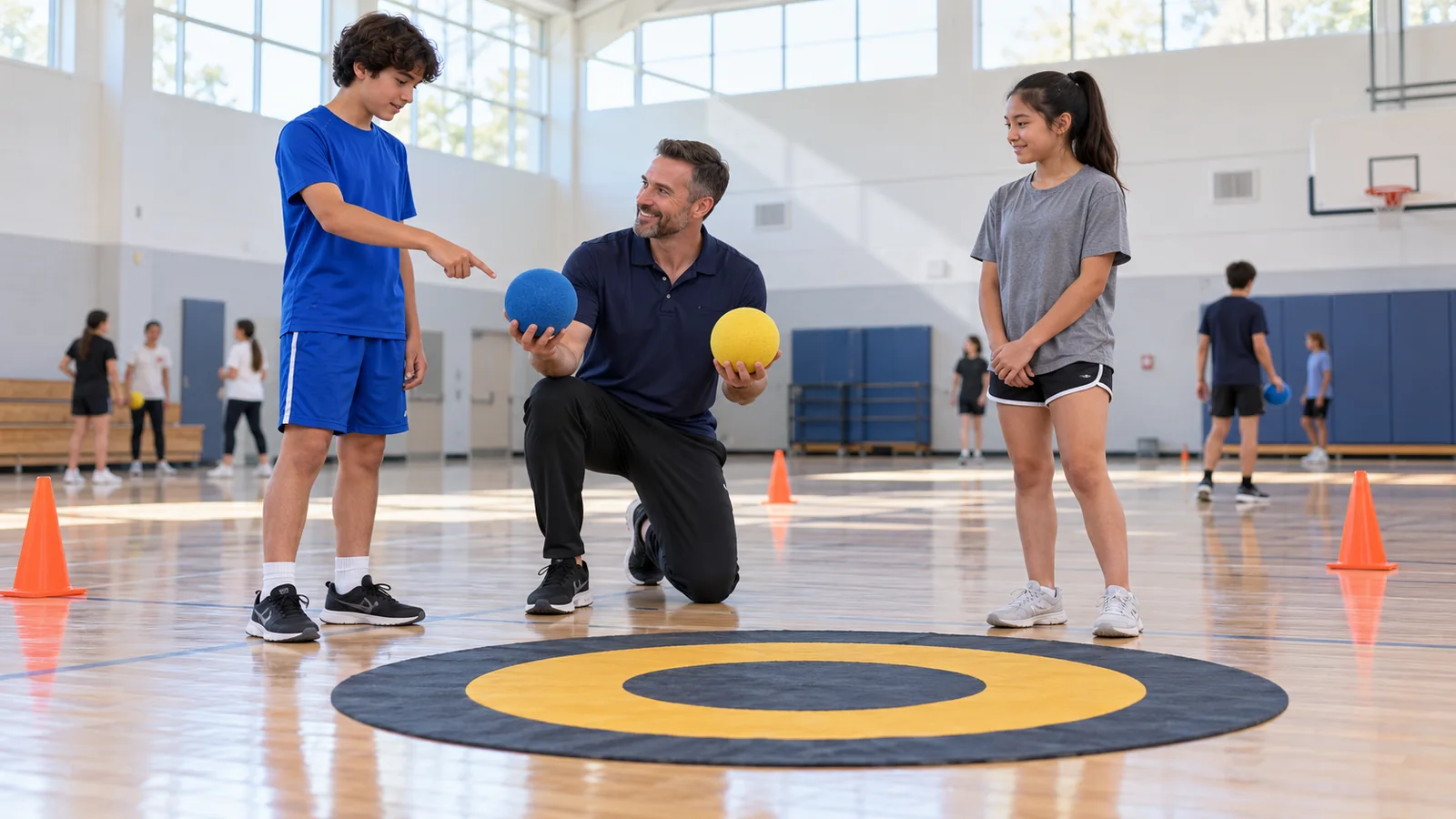
For an original example, if the goal is sending an object toward a target, the teacher could discuss how equipment, target placement or instructions affect access. The specific adaptation requires their assessment of the student, activity and safety rules. The aim is a real opportunity to practise the goal, not simply a different task that keeps the student occupied.
Keep safety and communication part of access
Ophea’s disability-centred safety considerations address equipment, facilities, instructions and supervision. Its communication section includes keeping communication supports accessible; its sensory section discusses environmental features and clear start-and-pause signals. These Ontario resources support planning but do not replace the activity-specific standards and individual plans applicable at the school.
Ask how the student can communicate “stop,” “help,” “I do not understand” or a relevant concern during movement. A communication device left somewhere inaccessible cannot serve that purpose. Work with the appropriate staff to decide where it can be kept safely and how it remains usable.
Where the student has an existing medical, mobility or support plan, confirm who reviews it for the activity. Changes involving specialised equipment, transfers or physical assistance need appropriately trained people. Do not assume a classmate can take over a staff responsibility.
Agree on participation that includes learning
- Goal: Name what the student is learning.
- Barrier: Identify the part of the current activity that limits access.
- Plan: Agree on an appropriate adaptation and responsible support.
- Review: Check learning, participation and the student’s experience.
A role such as keeping score or organising equipment can be valuable if it fits the learning purpose and the student wants it. It should not become the automatic role assigned whenever movement activities occur. Ask whether the student has equitable opportunities to learn the relevant physical skills with suitable support.
Likewise, practising separately for part of a lesson may be useful in some circumstances, but review how the student reconnects with peers and shared learning. Avoid treating identical activity as the only form of inclusion or permanent separation as the simplest solution.
Make assessment expectations understandable
Ask what evidence the teacher will use to assess the agreed learning. Is the student expected to demonstrate a skill, explain a strategy or show understanding in another way? Confirm how approved supports are used during assessment and whether any change to expectations is documented through the school’s process.
Do not assume that using different equipment automatically means the student is learning less. Equally, do not claim every alternative demonstrates the same skill. The teacher should explain the relationship between the task, curriculum expectation and evidence of learning.
Review after the arrangement is tried
Check whether the adaptation was available and whether instructions, equipment and support worked together. Ask the student what felt clear, enjoyable or difficult. A plan that looks inclusive on paper may still involve long waits, unwanted attention or inaccessible communication.
If participation remains difficult, revisit the barrier rather than simply increasing pressure. The next useful change may involve timing, environment or teaching method. Keep a brief record of what was agreed and who will follow up, especially when a different teacher, facility or activity is involved.
Common questions
Does an adaptation mean lowering expectations?
Not automatically. Some changes provide access to the same learning goal, while others change the expected learning. Ask the teacher to explain the distinction and the school’s terminology. The important point is understanding what the student is learning and how the chosen arrangement supports it.
Should a student be excused from PE because they are autistic?
A diagnosis alone does not determine participation or safe activity. Discuss the student’s needs, preferences, learning goals and any relevant individual plans. Decisions about specific activities should involve the responsible school staff and appropriate professionals where needed, rather than a blanket assumption about autism.
Can keeping score be a meaningful role?
It can, when it fits the learning purpose and the student wants the role. Review whether it also becomes a recurring substitute for learning physical skills. A student should not be assigned the same sideline task automatically whenever an activity requires adaptation.
What if the gym is the main barrier?
Identify the relevant features, such as sound, crowding, lighting or unclear boundaries. Discuss environmental and teaching changes with the school and check what is feasible. Do not assume that changing the activity alone will solve a difficulty that begins with entering or navigating the space.
Who decides whether equipment is suitable?
The responsible school staff should assess it against the activity, relevant standards and the student’s plans, involving qualified specialists where needed. A general article cannot establish suitability. Avoid modifying specialised equipment or introducing physical assistance without the appropriate knowledge and agreement.
How can communication supports be used during activity?
Plan how the student can understand instructions and express questions or concerns throughout the lesson. Confirm safe, accessible placement of any device or materials with relevant staff. Communication access should continue during transitions and movement, not only during the opening explanation.
What if the student dislikes competitive games?
Ask which aspect is difficult and what they enjoy. Competition, unclear rules, pace or group arrangements may be separate issues. Discuss ways to meet the learning goal with appropriate choices rather than assuming all physical activity is unwanted or requiring enthusiasm for one format.
Can a peer provide all the support?
Peer collaboration can be valuable, but classmates should not automatically take responsibility for specialised assistance, safety or supervision. Clarify adult responsibilities and the students’ preferences. A partner arrangement should support both learners without quietly replacing the staffing or expertise the plan requires.
How should an adapted task be assessed?
Ask the teacher which learning expectation it addresses and what evidence will demonstrate progress. Confirm the use of approved supports and any documented changes to expectations. Neither identical equipment nor identical performance should be assumed to be the only meaningful evidence without considering the goal.
When should the plan be revisited?
Review after trying the arrangement and when activities, facilities, staff or needs change. Include the student’s experience and check whether the planned support actually happened. A useful review can identify a practical access problem before it becomes a repeated pattern of missed participation.
Sources
Canadian physical education, provincial curriculum and Ontario safety guidance checked on 22 October 2026. The questions are educational planning prompts, not individual activity prescriptions or medical clearance.