Inclusive Education
Science Labs: Making Instructions and Equipment Access Clearer
Ask practical questions before a laboratory lesson so access and safety are planned together.
On this page
- At a glance
- Separate the learning goal from the current setup
- Prepare instructions before equipment is in use
- Check the actual workspace and equipment
- Keep access changes within the safety process
- Agree on meaningful group roles
- Make communication work during the activity
- Include recording and follow-up in the plan
- Common questions
- Sources
A science laboratory asks students to follow procedures, use equipment, observe changes, record information and communicate with others. Access can break down at any of those stages. Planning ahead helps the student and school identify what needs explaining or adapting before an activity begins.
Start with the science teacher and the student, involving relevant accessibility, support and safety staff as needed. This guide is a discussion framework, not a laboratory procedure or permission to alter an experiment. The teacher must assess the particular activity, equipment, hazards and applicable school requirements.
Separate the learning goal from the current setup
Ask what the practical activity is intended to teach. Students might be learning to observe, measure, compare results, use a particular instrument or explain a scientific relationship. Understanding that purpose helps the school examine which parts of the current setup create unnecessary barriers.
The American Chemical Society’s guidance on laboratory experience connects practical learning with accessibility and safety. It describes preparation, the laboratory activity and follow-up analysis as linked parts of teaching. Its US educational context does not establish Canadian legal or curriculum requirements, but the structure is useful for planning access across the whole lesson.
Do not assume a student must be excluded because one tool is inaccessible. Equally, do not claim that any substitute activity demonstrates the same learning. Ask the teacher to explain how an adaptation or alternative connects to the curriculum goal and what evidence of learning will be assessed.
Prepare instructions before equipment is in use
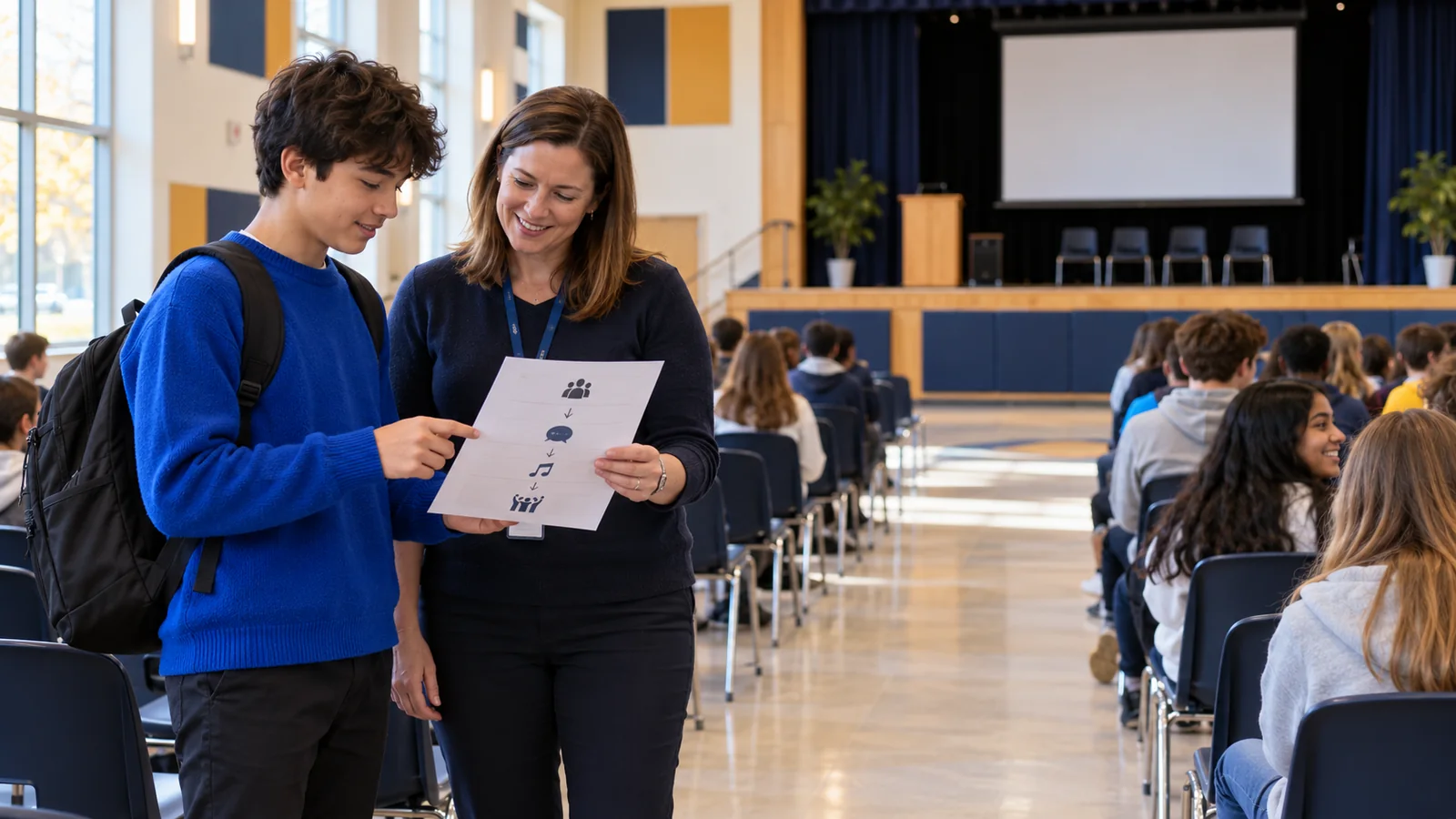
Ask whether the student can review the procedure in advance in a usable format. Identify unfamiliar words, symbols and equipment names. A short sequence can help organise a complex task, but it must not remove safety-critical information or contradict the teacher’s instructions.
Consider how instructions will remain available during the activity. If the student must alternate between a demonstration, a worksheet and a screen, discuss how to make that manageable. Check whether they can see the demonstration and distinguish the relevant equipment without relying on colour alone.
Agree on how to ask for clarification before proceeding. Students should know that uncertainty about a step is a reason to pause and consult the responsible teacher. Avoid creating pressure to keep pace with a partner when the procedure is not understood.
Check the actual workspace and equipment
The University of Washington’s AccessComputing guidance on science labs identifies facilities, equipment, materials and safety systems as parts of access. It emphasises individual needs, orientation and active participation. Use those planning principles while relying on current local expertise for specific equipment or procedural decisions; this article does not adopt every technical example on that page.
Ask whether the student can reach the work area, read or otherwise access measurements, use the required controls and keep needed communication supports available. Consider the route around the room and access to the relevant safety arrangements. A clear desk alone does not establish that the whole lab is accessible.
| Area | Question to resolve | Who should confirm the arrangement? |
|---|---|---|
| Procedure | Can the student understand and revisit each required step? | The science teacher with the student |
| Equipment | Can the student access controls and information safely? | Responsible staff, with specialist input where needed |
| Communication | How will questions, pauses and urgent instructions be communicated? | The teacher and relevant support staff |
| Group roles | Does each student have a meaningful contribution? | The teacher and students |
| Environment | Are routes, seating and sensory features suitable for the activity? | The teacher and school staff responsible for the space |
| Review | How will access and learning be checked afterward? | The teacher with the student’s feedback |
Keep access changes within the safety process
A modification that works for a classroom worksheet may not be suitable around laboratory equipment or materials. Ask staff to assess any proposed change to protective equipment, tools, positioning, timing or assistance. Do not improvise an equipment alteration from a general accessibility article.
The Public Health Agency of Canada’s school-classroom biosafety guidance concerns risks associated with microbes and is directed to teachers, support personnel and parents. It illustrates that relevant safety guidance depends on what an activity involves. It is not a complete source for every chemical, electrical or physical hazard in a science lesson.
Ask how the student’s access needs fit the school’s established risk assessment and emergency arrangements. If a proposed support conflicts with a required procedure, responsible staff need to identify an appropriate solution before the activity proceeds. Safety and access should be planned together, rather than using either as a reason to skip the discussion.
Agree on meaningful group roles
- Prepare: Clarify the goal, procedure and access needs.
- Confirm: Check equipment, roles and safety arrangements.
- Participate: Keep instructions and help available during the activity.
- Reflect: Review observations, learning and remaining barriers.
A partner can support collaboration, but should not automatically do all the practical work while the disabled student watches. Discuss roles such as making predictions, directing an agreed sequence, using accessible equipment, recording observations or analysing results in relation to the learning goal.
Check whether roles can change over time so the student has opportunities to develop relevant skills. An assistant may provide access to part of a task, but the student’s decisions and understanding should remain visible. A classmate should not be assigned responsibility for specialised assistance or safety that belongs to trained staff.
Make communication work during the activity
Ask how the student will receive a stop instruction and communicate a question, discomfort or a need for help. Use a method they can access in the actual environment. A spoken cue may be difficult to hear; a visual cue may be missed if the student is focused elsewhere. Staff need an appropriate plan for the situation.
Keep necessary communication tools safely accessible and confirm any restrictions related to the activity. Explain who responds when the usual support person is absent. Avoid a plan that requires the student to leave a supervised workspace or navigate an unfamiliar process merely to obtain clarification.
Include recording and follow-up in the plan
Discuss how the student will record observations without losing access to the activity itself. A suitable format might involve an accessible table, agreed assistive technology or another method approved by the teacher. Distinguish recording support from someone else interpreting the results on the student’s behalf.
Afterward, ask what the student observed and how they explain it. Review whether the support was available, instructions were usable and the role allowed meaningful learning. If the activity was inaccessible, record the barrier and the next action rather than interpreting incomplete work as a lack of scientific understanding.
Revisit arrangements for each materially different practical activity. A plan for observing prepared slides may not answer the access or safety questions of another experiment. Keep the focus on the specific task, the student’s participation and the staff responsible for confirming a workable approach.
Common questions
Should a student be excluded from labs because of a disability?
A diagnosis alone does not determine access or safe participation. Discuss the actual activity, learning goal and individual needs with responsible school staff. They should assess barriers and appropriate arrangements rather than assuming exclusion or promising that every procedure can proceed without changes.
Can a simplified instruction sheet leave out safety details?
No. Making language or layout clearer should not remove essential information or conflict with the teacher’s procedure. Have the responsible teacher review any adapted instructions. The student needs a usable way to understand the activity, including when to stop and ask for clarification.
Can we modify equipment ourselves?
Do not improvise laboratory equipment changes from a general article. Suitability depends on the device, materials, activity and relevant safety requirements. Ask responsible staff and appropriate specialists to review proposed adaptations before use, including how they affect measurements, handling and emergency arrangements.
Is watching a partner enough participation?
Observation can be meaningful for some learning goals, but should not automatically become the student’s only role. Discuss how they can contribute to the investigation and demonstrate understanding. Check whether recurring observation-only roles reflect unresolved access barriers rather than an agreed educational purpose.
Can a classmate provide specialised assistance?
Peer collaboration is different from responsibility for specialist support or safety. Clarify which tasks belong to trained staff and what classmates have agreed to do. The arrangement should support both students without quietly transferring adult responsibilities to a peer.
What if protective equipment is uncomfortable or inaccessible?
Raise the issue before the activity so responsible staff can assess appropriate options. Do not remove, substitute or alter required protection informally. The solution needs to address both access and the specific hazard, with qualified input where the school’s process requires it.
How can a student ask questions without speech?
Use their established communication method and plan how it remains safely accessible in the lab. Confirm that staff know how to notice and respond. The method must work during the activity, not only while discussing the lesson in a quieter classroom beforehand.
Does one access plan cover every experiment?
No. Different equipment, materials, spaces and procedures can create different requirements. Reuse relevant information, but review the plan when the task changes materially. A successful arrangement for one observation activity does not automatically establish suitability for another practical investigation.
Are online safety resources enough to approve an activity?
No. They can inform responsible staff, but the school must apply relevant local requirements and assess the actual activity and participants. Different resources address different hazards and jurisdictions. A general accessibility guide is not a complete risk assessment or an approval to proceed.
What should be reviewed after the lab?
Check both scientific learning and access: what the student understood, could do and could communicate, and whether the agreed support happened. Identify practical barriers separately from conceptual difficulties. Use that information to plan the next activity rather than judging only the final worksheet.
Sources
Primary chemistry-education, university accessibility and Canadian biosafety guidance checked on 22 October 2026. Only the stated planning principles and source scopes are used; no experiment, equipment modification or individual safety approval is provided.